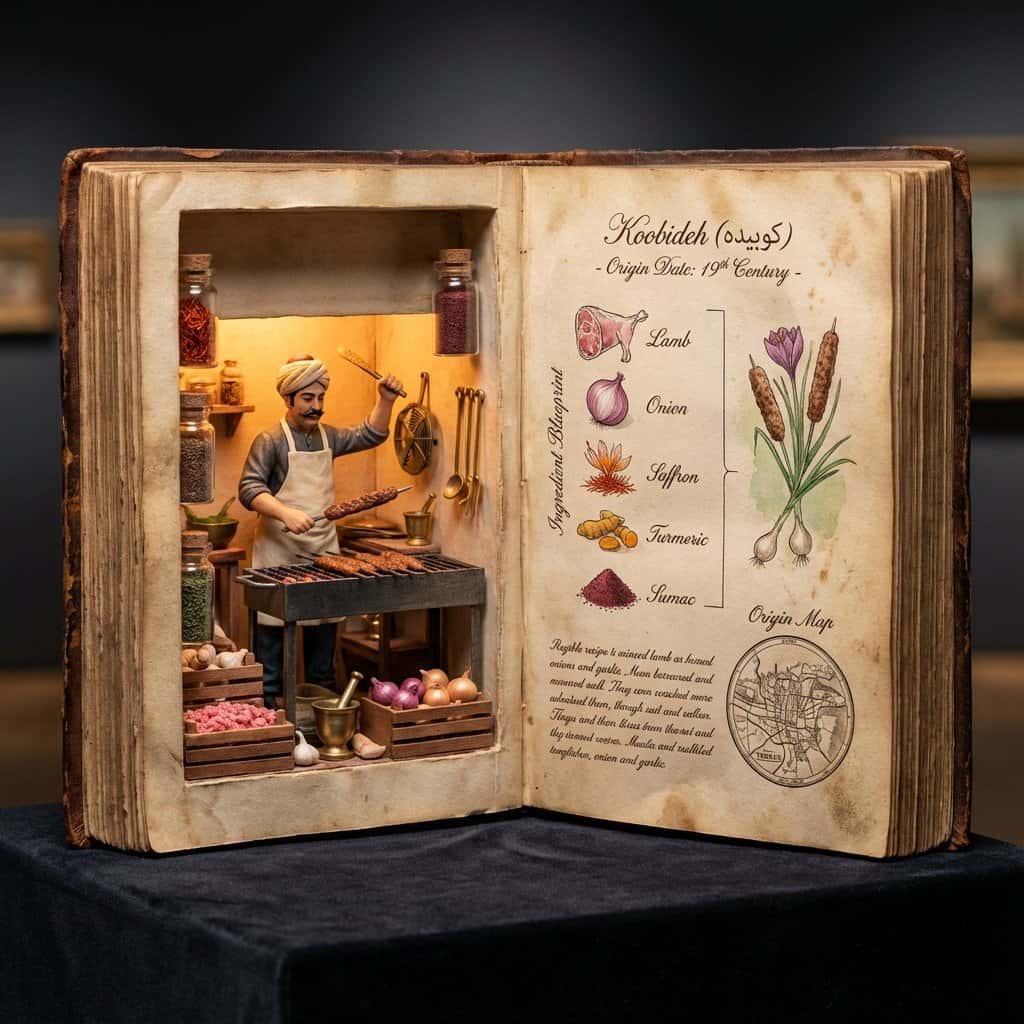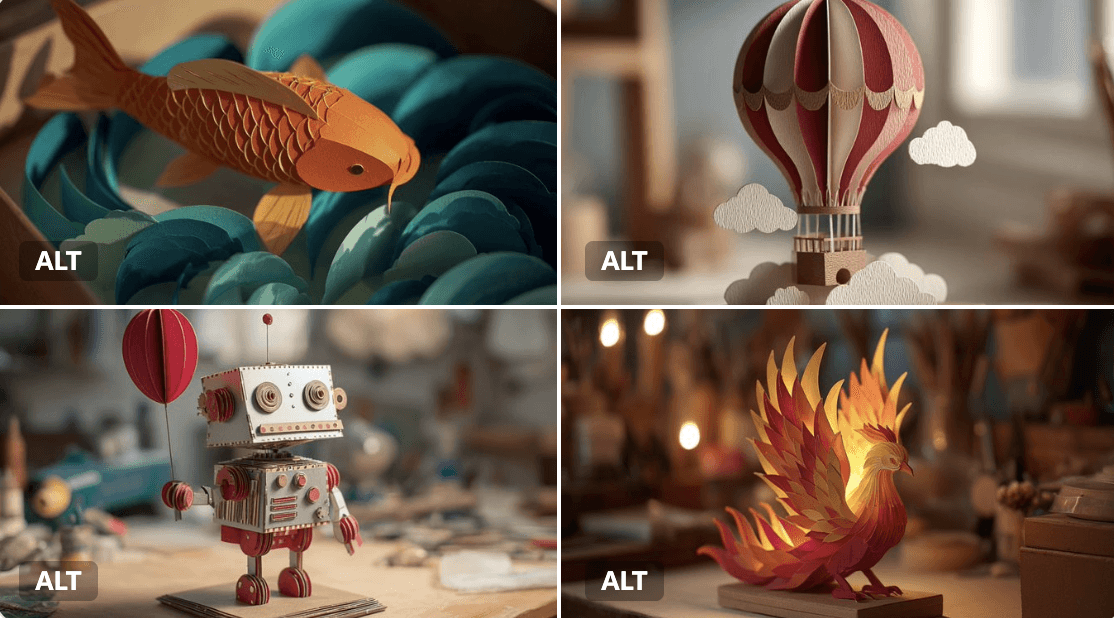
prompt
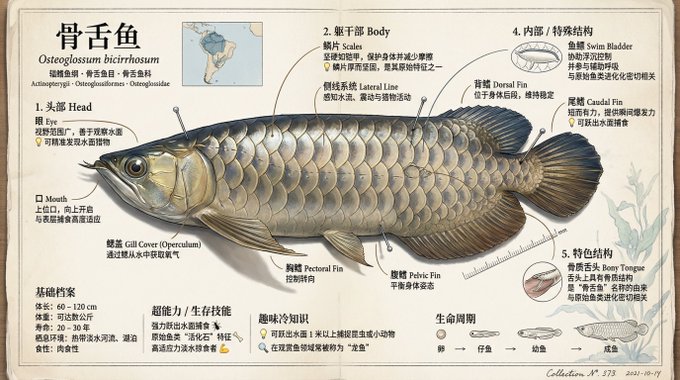
Please create a museum-grade fish knowledge infographic, focusing on displaying a representative fish species, such as: tuna / carp / shark / clownfish (can be replaced).

Core Layout:

Center: A large fish specimen image, occupying 60–70% of the frame.

Surrounding: Scientific labels + interesting encyclopedia information, presented in a radial or partitioned layout.

Overall: Like a fish specimen description card in a museum glass display case.

Fish Specimen Presentation (Core Requirements):

Physical Realism
The fish specimen is realistically laid flat on the paper surface.
Not a “photo of a photo,” but a physical specimen.

Perspective
Top-down view.
The fish body is on the same physical plane as the paper.

Lighting and Shadow
Soft natural light shines from above.
The fish body casts delicate, realistic shadows on the paper.

Fixing Method (Natural History Style)
Use slender silver metal specimen pins or fine threads to secure the fish body.
The pin passes through key parts of the fish body (such as the back or fin base).
The pin tip slightly pierces the paper surface.
Small pinholes and slight indentations are visible on the paper.

Detail Texture (Focus)
Clearly visible:
Fish scale arrangement and reflections.
The translucent texture of the fin membranes.
The structural layers of the gill cover.
The moist reflection in the eyes.
The edges of the fish body have a sense of thickness and slight three-dimensional undulation.
The fins may be naturally spread but not overly exaggerated.

Proportion
The fish specimen occupies about 60–70% of the center of the paper.
Whitespace is left around for labels and information explanations.

Natural State
The fish body posture is natural and relaxed.
Retain the static feel of a “real specimen,” rather than a swimming posture.

Labeling System Design:

Use fine guiding lines.

Extend from the fish body structure to the text description box.

The guiding lines appear as if directly drawn or printed on the paper.

Required labeled body parts (6–8):

1. Head

Eye
Field of vision? Can it see colors?

Mouth
Mouth shape (superior mouth / terminal mouth / inferior mouth)
Related to diet?

Gill Cover (Operculum)
Explanation of breathing method (how it obtains oxygen from water).

2. Body

Scales
Types (cycloid / ctenoid / ganoid).
Protection and drag reduction functions.

Lateral Line
The sensory organ for perceiving water flow and vibrations.

3. Fin System

Dorsal Fin: Maintains balance.

Pectoral Fin: Steering and braking.

Pelvic Fin: Stabilizes the body.

Caudal Fin: Main propulsion force.
Explanation of swimming speed or burst power.

4. Internal/Special Structures (Visual Expression)

Swim Bladder (if applicable)
Controls buoyancy.

Or

Comparison of cartilaginous and bony structures.

5. Characteristic Structures

The most representative physical features of this fish species.

Relationship with its habitat (marine / freshwater / deep sea / coral reef).

Information Card Content (each label includes):

Part Name (Chinese / English)
1–2 sentences of child-friendly functional explanation.

Interesting data or trivia.
Marked with 🔍 or 💡 icons.

Other Page Elements:

Top Area:

Chinese Name of the Fish (large title, elegant font).

Scientific Name (italicized Latin).

Classification Information (Class / Order / Family).

Distribution Map Icon
World map + highlighting major distribution waters.

Bottom/Side Information Bar:

Basic Profile

Body Length: X cm – X m.

Weight: X g – X kg.

Lifespan: X years.

Habitat: Marine / Freshwater / Deep Sea / Coral Reef.

Diet: Herbivorous / Carnivorous / Omnivorous.

Superpowers / Survival Skills

2–3 coolest abilities, such as:
High-speed swimming.
Electroreception.
Color-changing camouflage.
Migration ability.

Icons + brief descriptions.

Interesting trivia.

1–2 facts that attract children.

For example:
“Can sleep without blinking.”
“Can swim thousands of kilometers in a lifetime.”

Life Cycle

Simplified diagram: Egg → Fry → Juvenile → Adult.

Highlight key changes in growth stages.

Design Aesthetics (Maintain Natural History Style):

Paper Texture

Base Paper:
Off-white / ivory high-quality paper.
#F8F6F0 or #FFFEF7.

Visible paper fibers.

Slight vintage wear (optional).

Spatial Relationships (Very Important)

Fish specimen: a real physical entity, laid flat on the paper.

Fixing pins/threads: silver metal texture.

Label text: directly printed or handwritten on the same paper.

Guiding lines: fine pen-drawn lines.
Color Scheme

Paper background color: #F8F6F0 / #FFFEF7.

Label text: #2C3E50 (dark gray-blue ink).

Guiding lines: #8B7355 or #696969.

Highlight marks: #D4AF37 (antique gold).

Specimen pins: #C0C0C0 (silver-gray metal).

Font System
Title: Elegant serif or handwritten style (Songti / Garamond).

Scientific Name: Italic.

Label Descriptions: Clear small handwritten or printed font.

Overall Feel:
Like a naturalist's handwritten notes on fish observations on specimen paper.

Decorative Elements (Optional)

Corner decorative borders.

Millimeter scale (parallel to the fish body).

Collection number / date (handwritten style).

Aquatic plant silhouette watermark (very faint).

Key Visual Points (Non-Negotiable):

The entire image is a flat fish specimen paper.

The fish specimen is realistically fixed to the paper surface.

Text, lines, and specimens share the same physical plane.

The viewer feels as if they are looking down at a naturalist's workbench.

Key Concept Emphasis:

❌ Do not: A photo of the fish placed in the image.

✅ Must: The fish specimen itself is on the paper.

Like a page from a 19th-century naturalist's fish specimen book.

Image Specifications:

Aspect Ratio: 16:9 (landscape) or 3:4 (portrait).

Resolution: 300 DPI, suitable for A3 / A2 printing.

Format: PNG high definition.

Scientific Accuracy Requirements:
The fish body proportions match the real species.

Anatomical structure names are accurate.

Children's descriptions are vivid yet scientific.
Related prompts
Suggested alternatives based on similar intent and language.

Museum-Quality Insect Knowledge Infographic
This prompt is for educators and designers creating engaging insect infographics for children, helping to produce informative and visually appealing educational materials.
Why creators keep returning to AI Prompt Copy
AI Prompt Copy grew from late-night experiments where we packaged the most effective prompt ideas into a single workspace so every creator could ship faster.
Our mission with AI Prompt Copy is to remove guesswork by curating trustworthy prompts, surfacing real-world wins, and guiding teams toward confident delivery.
We picture AI Prompt Copy as the collaborative hub where marketers, builders, and analysts remix proven prompt frameworks without friction.
Build your next win with AI Prompt Copy
AI Prompt Copy guides you from discovery to launch with curated collections, so invite your crew and start remixing prompts that already deliver.
Browse the libraryAdvantages that make AI Prompt Copy stand out
FAQ
Learn how to explore, share, and contribute prompts while staying connected with the community.
How should I tailor Museum-Grade Fish Knowledge Infographic before running it?
Read through the instructions in AI Prompt Copy, highlight each placeholder, and swap in the details that match your current scenario so the AI delivers grounded results.
What is the best way to collaborate on this prompt with my team?
Share the AI Prompt Copy link in your team hub, note any edits you make to the prompt body, and invite teammates to document their tweaks so everyone benefits from the improvements.
How can I save useful variations of this prompt?
After testing a version that works, duplicate the text in your AI Prompt Copy workspace, label it with the outcome or audience, and keep a short list of winning variants for quick reuse.
What can I do with AI Prompt Copy?
Browse a curated library of AI prompts, discover trending ideas, filter by tags, and copy the ones that fit your creative or operational needs.
How do I use a prompt from the AI Prompt Copy library?
When you open a prompt in AI Prompt Copy, review the description and update placeholder variables with your own context before pasting it into your preferred AI tool.
How can I share AI Prompt Copy prompts with my team?
Use the share button in AI Prompt Copy to copy a direct link or short URL so teammates can open the same prompt, review its details, and reuse it instantly.
Can I submit my own prompts to AI Prompt Copy?
Yes. Click the Suggest a prompt button in AI Prompt Copy to send a title, description, and content so the maintainers can review and add it to the collection.
Where do AI Prompt Copy prompts come from?
Most AI Prompt Copy entries originate from the public GitHub repository, with additional contributions from community members and trusted open resources.
How do I leave feedback or report an issue?
Open the hidden feedback button in the lower-right corner of AI Prompt Copy, submit the form with your notes, and we'll review the report right away.
How do I onboard new teammates with our prompt playbook?
Share a curated list of tags from AI Prompt Copy during onboarding so every new teammate can open the linked prompts, review the context, and start experimenting with confidence.
What workflow keeps campaign collaborators aligned?
Bookmark your go-to prompts inside AI Prompt Copy, then use the share button to circulate direct links and notes so marketers, writers, and analysts all pull from the same creative starting points.
Can I adapt prompts for teams in regulated industries?
Yes. Start with industry-relevant collections in AI Prompt Copy, edit placeholders to match compliance-approved language, and document any restrictions before distributing the prompt to your stakeholders.
Where do I find help tailoring prompts to my use case?
Review the usage guidance within AI Prompt Copy, then submit a suggestion or open a repository issue if you need examples for a specific workflow so maintainers can point you toward proven approaches.