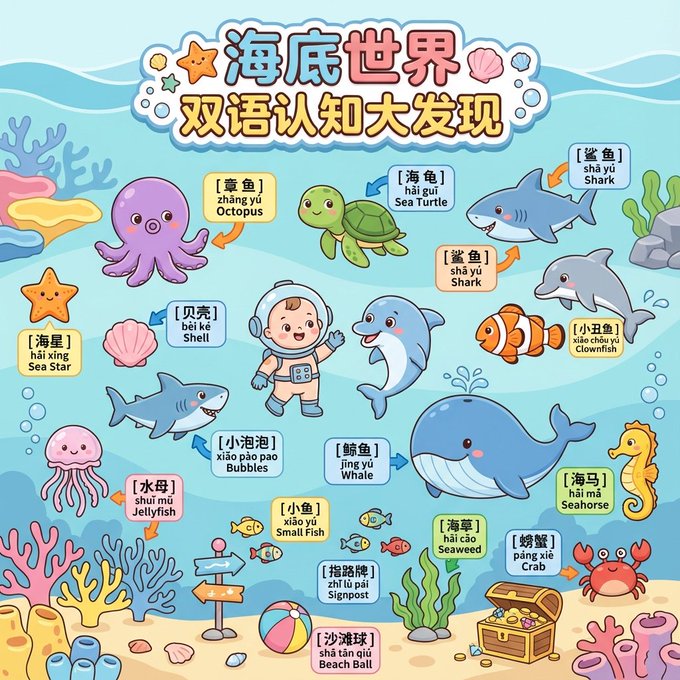
Bilingual Cognitive Discovery - Underwater World
prompt
[SCENE_THEME] = Underwater World
[TARGET_AGE] = 2–5 years old

Generate a publishable-level children's cognitive "flat Q version cartoon" panoramic long image of the underwater world (Vertical A4 Panoramic Flat Cute Cartoon). Overall style: bold lines, rounded shapes, bright yet soft colors, safe style with no sharp corners, large shapes, high contrast, simplified cartoon graphics suitable for young children's cognition. The image should be clean, clear, and logical, with distinct object boundaries. Resolution should be ultra-clear 8K.

# I. Title Area (Top Banner)
Add a large title at the top: "Underwater World Bilingual Cognitive Discovery."
Font: extra-large rounded cartoon font (full, colorful, soft shadow).
Add cute cartoon ocean icons (mini starfish, small shells, small bubbles) on both sides.

# II. Main Scene (Main Panorama)
Composition: ultra-wide flat cartoon underwater scene. The foreground and midground should be as clear as possible, avoiding complex depth of field; maintain a simple, clean, child-friendly division. Overall, it should look like an "underwater paradise map."

Element requirements:
- All marine creatures should be big-headed Q version cartoons
- Bold lines, soft edges
- Bright colors, clear contrast
- Simple structure for easy shape recognition by children

Include 1–2 guiding characters (Q version diving baby / little dolphin friend) to lead the viewer's gaze with exaggerated actions.

# III. Cognitive Object List (Core Objects)
All objects should be: rounded, flat, cartoonish, large surfaces, easily recognizable.

【Core Large Items (5–8 items)】
Octopus
Sea Turtle
Shark
Dolphin
Clownfish
Whale
Seahorse
Crab

【Medium and Small Items (8–12 items)】
Starfish
Shells
Jellyfish
Coral
Small bubble clusters
Small fish (multi-colored)
Seagrass
Beach ball
Treasure chest
Underwater signpost

【Environmental Elements (unlimited)】
Simplified waves, flat coral reefs, light-colored seabed sand, shell fragments, bubble trails, Q version rocks.

# IV. Bilingual Labeling System
Add three-line labels for all main cognitive objects (flat rounded rectangle, soft color background, simple cartoon style).

Fixed format:
First line: Chinese (bold rounded font)
Second line: Pinyin with tones
Third line: English (rounded sans-serif)

Example:
[ 章 鱼 ]
[ zhāng yú ]
[ Octopus ]

Label colors: light cream yellow or light blue
Font: clear, bold, easy to read
Labels should be placed in the blank area near the objects.

# V. Directional Arrows (Flat Cute Arrow)
Use flat cartoon style arrows:
- Bold lines, round heads
- Eye-catching colors (orange / blue)
- One end connects to the label, the other end is close to the object boundary
- No crossing of arrows, maintain overall cleanliness and order.

# VI. Style Cohesion (Unified Output)
Flat Cute Cartoon Style;
Bright & Soft Color Palette;
Round Shapes & Child-safe Edges;
Clean Separation of Elements;
Bilingual Labels + Clear Arrows;
8K Ultra HD;
Simple, Fun, Easy-to-read Composition.
Related prompts
Suggested alternatives based on similar intent and language.
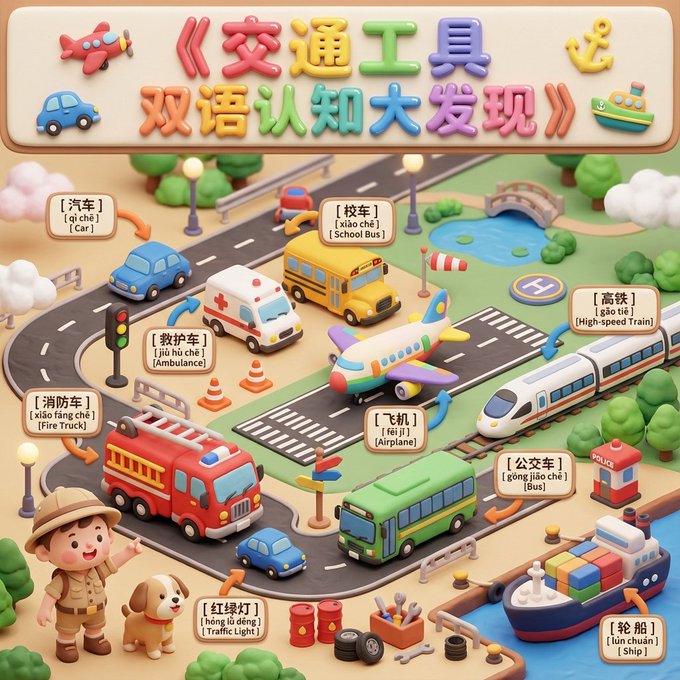
Bilingual Cognitive Discovery - Transportation
This prompt is for educators creating engaging bilingual learning materials for young children, helping them explore transportation concepts through a visually appealing diorama.
Why creators keep returning to AI Prompt Copy
AI Prompt Copy grew from late-night experiments where we packaged the most effective prompt ideas into a single workspace so every creator could ship faster.
Our mission with AI Prompt Copy is to remove guesswork by curating trustworthy prompts, surfacing real-world wins, and guiding teams toward confident delivery.
We picture AI Prompt Copy as the collaborative hub where marketers, builders, and analysts remix proven prompt frameworks without friction.
Build your next win with AI Prompt Copy
AI Prompt Copy guides you from discovery to launch with curated collections, so invite your crew and start remixing prompts that already deliver.
Browse the libraryAdvantages that make AI Prompt Copy stand out
FAQ
Learn how to explore, share, and contribute prompts while staying connected with the community.
How should I tailor Bilingual Cognitive Discovery - Underwater World before running it?
Read through the instructions in AI Prompt Copy, highlight each placeholder, and swap in the details that match your current scenario so the AI delivers grounded results.
What is the best way to collaborate on this prompt with my team?
Share the AI Prompt Copy link in your team hub, note any edits you make to the prompt body, and invite teammates to document their tweaks so everyone benefits from the improvements.
How can I save useful variations of this prompt?
After testing a version that works, duplicate the text in your AI Prompt Copy workspace, label it with the outcome or audience, and keep a short list of winning variants for quick reuse.
What can I do with AI Prompt Copy?
Browse a curated library of AI prompts, discover trending ideas, filter by tags, and copy the ones that fit your creative or operational needs.
How do I use a prompt from the AI Prompt Copy library?
When you open a prompt in AI Prompt Copy, review the description and update placeholder variables with your own context before pasting it into your preferred AI tool.
How can I share AI Prompt Copy prompts with my team?
Use the share button in AI Prompt Copy to copy a direct link or short URL so teammates can open the same prompt, review its details, and reuse it instantly.
Can I submit my own prompts to AI Prompt Copy?
Yes. Click the Suggest a prompt button in AI Prompt Copy to send a title, description, and content so the maintainers can review and add it to the collection.
Where do AI Prompt Copy prompts come from?
Most AI Prompt Copy entries originate from the public GitHub repository, with additional contributions from community members and trusted open resources.
How do I leave feedback or report an issue?
Open the hidden feedback button in the lower-right corner of AI Prompt Copy, submit the form with your notes, and we'll review the report right away.
How do I onboard new teammates with our prompt playbook?
Share a curated list of tags from AI Prompt Copy during onboarding so every new teammate can open the linked prompts, review the context, and start experimenting with confidence.
What workflow keeps campaign collaborators aligned?
Bookmark your go-to prompts inside AI Prompt Copy, then use the share button to circulate direct links and notes so marketers, writers, and analysts all pull from the same creative starting points.
Can I adapt prompts for teams in regulated industries?
Yes. Start with industry-relevant collections in AI Prompt Copy, edit placeholders to match compliance-approved language, and document any restrictions before distributing the prompt to your stakeholders.
Where do I find help tailoring prompts to my use case?
Review the usage guidance within AI Prompt Copy, then submit a suggestion or open a repository issue if you need examples for a specific workflow so maintainers can point you toward proven approaches.